

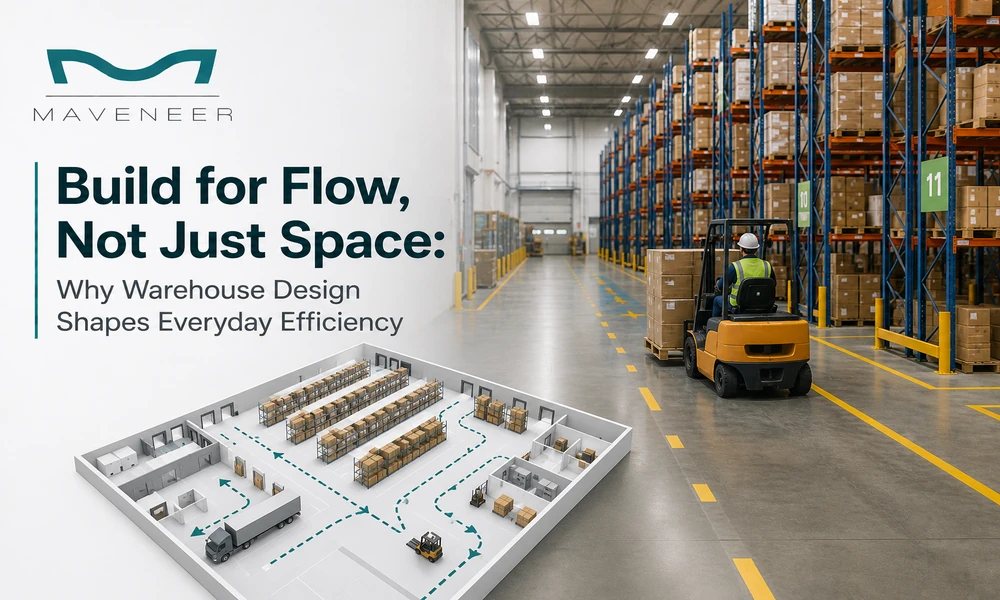
A warehouse can be many square meters in size, but still not be able to meet demand. Space is not necessarily the issue − and that increases the problem. It is not how much space there is, but more how that space is organized. Productivity is impaired because it takes too long to find products, a forklift travels across busy walkways, or a line of packing stations becomes overloaded.
Which is exactly why warehouse design is about far more than simply stacking shelves in a building. Good layout helps people, materials, and equipment flow together with less waiting and fewer errors.
Begin with the Product Journey
Each item has a route it takes through the warehouse. It gets to the receiving dock, checked in, stored in inventory (shelved), picked, packed, and shipped to customer. If step one causes an extra movement, all four processes get slowed down.
Understanding that journey is where good warehouse design starts. Put the products that are selling fast close to packing stations, and inventory that moves slower in deeper. Over a year, this one change saves you hours of time.
Not All Businesses are Equal
An online fashion store needs an entirely different storage than a furniture distributor. Higher load products need wide aisles and heavy-duty racking, and smaller products use compact storage shelving and fast pick zones.
- Product size and weight
- Daily order volume
- Receiving and shipping schedules
- Type of handling equipment
- Future business growth
Probably the best warehouse design mirrors how the true business operates rather than a stock form.
Creating Safe and Efficient Workspaces
A well-managed and systematized warehouse is also a safe place to work. There are fewer friction whenever employees can stroll across the board without dealing with obstacles.
A few simple design choices can increase both safety and productivity:
- Clearly marked traffic routes
- Separate pedestrian walkways
- Well-positioned packing stations
- Adequate lighting throughout the facility
- Easy access to emergency exits
These features reduce workplace risks while facilitating daily operations.
Leave Room for Tomorrow
The warehouse building mistake − designing the warehouse for just current inventory. Business evolves, consumer demand shifts, and fresh product lines are launched.
Flexible warehouse designs are those that provide room for expansion without the need to redesign, such an infrastructure entirely. Stay open to the designs, such as modular workstations, where the operations can be adjusted in its scale; rack systems, as well as organized storage zones.
Preventative foresight is cheaper than damage control measures.
Good Design Supports Long-Term Success
Keep in mind that a good warehouse isn’t measured by the quantity of items it can hold. It is quantified by the change-over time between arrival and dispatch of products. Good design of your warehouse can decrease unnecessary travel, enhance safety, and create a workflow that supports both employees and customers. As businesses evolve, investing in an efficient design pays dividends for many years beyond the warehouse floor. When warehouse design is right, it helps scale current operations and shapes agile enough businesses that are willing to respond confidently to future supply requirements.
